

Lesson 02 • Conversational Mechanics

WRITE THE TURN IN THE CONVERSATION

In real life, nobody stands across from a suspect or a heartbroken friend and reads down a bulleted checklist of five unrelated topics before clicking "Return to previous topics." Yet for decades, digital roleplaying games and early hypertext stories defaulted to the "Hub-and-Spoke" interrogation tree.

When a conversation loops endlessly back to its starting prompt, dramatic tension evaporates. Time freezes while the player vacuums up lore. To make interactive dialogue feel alive, treat every spoken line as an irreversible move in a social negotiation.

Two narrative designers sitting by a window reading an interactive dialogue script aloud to test rhythm and subtext

MOVING BEYOND THE LORE VENDING MACHINE

In dramatic writing, a "turn" is the beat where the temperature in the room changes—an accusation is levelled, a secret slips out, or an offer is rejected. In interactive dialogue, the reader should be the one steering those turns.

Instead of organizing choices by noun ("Ask about the syndicate", "Ask about the lighthouse"), organize choices by social tactic ("Press him on his alibi", "Change the subject to protect his pride", "Offer to share the blame"). When the reader picks a tactic, the non-player character (NPC) responds to the emotional pressure, and the conversation moves forward to a new beat rather than rewinding.

Side-by-Side Structure: Hub Loop vs. Flowing Weave

Notice how the Flowing Weave approach (popularized by Inkle's Ink scripting language and modern narrative adventures like Oxenfree) advances the scene clock with every exchange:

Exchange Beat Exhaustive Hub Tree (Static) Forward-Moving Weave (Dynamic)
Beat 1: The Greeting Stationmaster greets you. Menu shows 4 static questions about trains, weather, union strike, and ticket prices. Stationmaster is hurriedly locking the telegraph room as the 9:15 whistle blows down the valley.
Beat 2: Player Choice Player clicks all 4 questions one after another while the train unrealistically waits forever. Player can only ask one urgent question before the train pulls in, OR wedge a boot in the telegraph door.
Beat 3: NPC Reaction Stationmaster repeats his idle animation and waits for the "Exit Conversation" button. If asked about the strike, he hands you a union leaflet; if you wedged the door, he calls for the porter. Scene advances immediately.

THREE PRACTICAL TECHNIQUES FOR BETTER DIALOGUE

Close-up of script notes comparing button intent labels with full spoken dialogue lines Clarity of Intent

Align Paraphrase and Voice

Nothing frustrates a reader faster than clicking a short prompt that reads "Disagree politely" only for their protagonist to shout an insult and draw a weapon. Write the exact spoken line in the choice button, or pair a clear tactical verb with the opening clause of the dialogue.
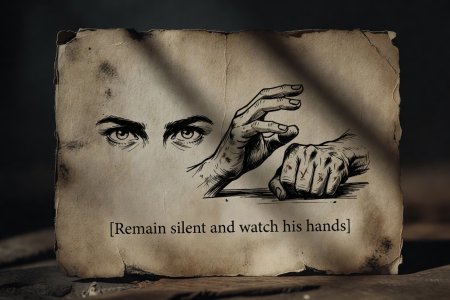

Story card showing '[Remain silent and watch his hands]' as a third dialogue option Active Silence

Use Silence as a Weapon

Saying nothing is often the most powerful choice in a tense room. Including an option like "[Say nothing. Wait for her to fill the silence.]" gives observant readers a way to apply psychological pressure without speaking a word.

Diagram connecting an early dialogue promise to a late-game character callback Callback Memory

Echo Earlier Promises

Track how the player spoke to an NPC in Chapter 1. Even a single customized sentence in Chapter 4—"You told me back at the docks you didn't care about the money"—makes the character feel genuinely perceptive.

Ready to organize your scenes and conversational weaves into a coherent architecture?

SEE EVERY POSSIBLE ROUTE